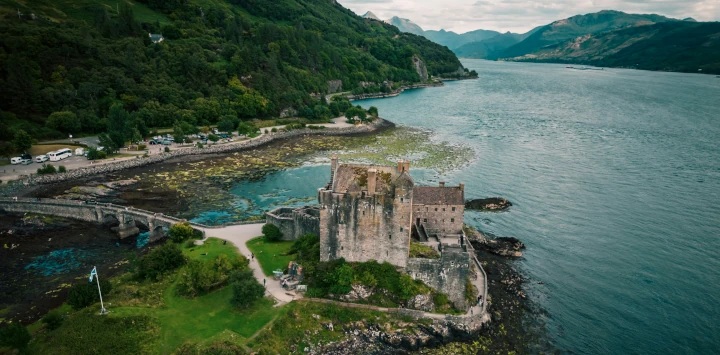
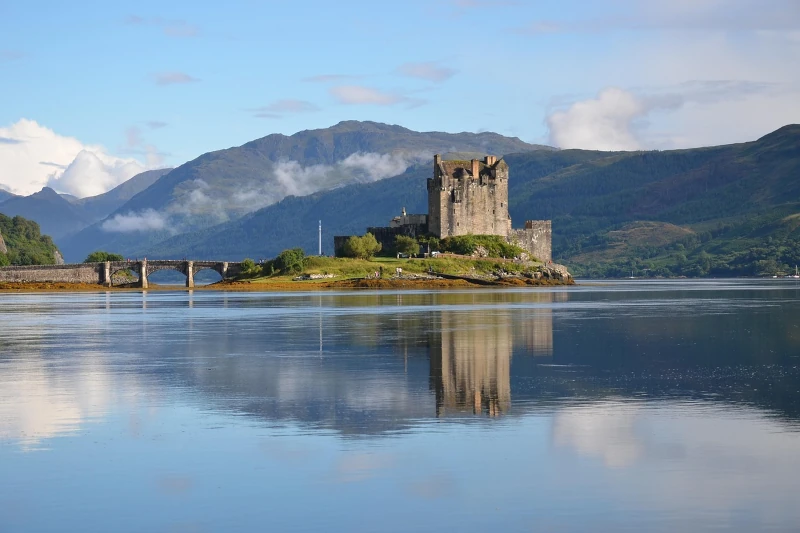
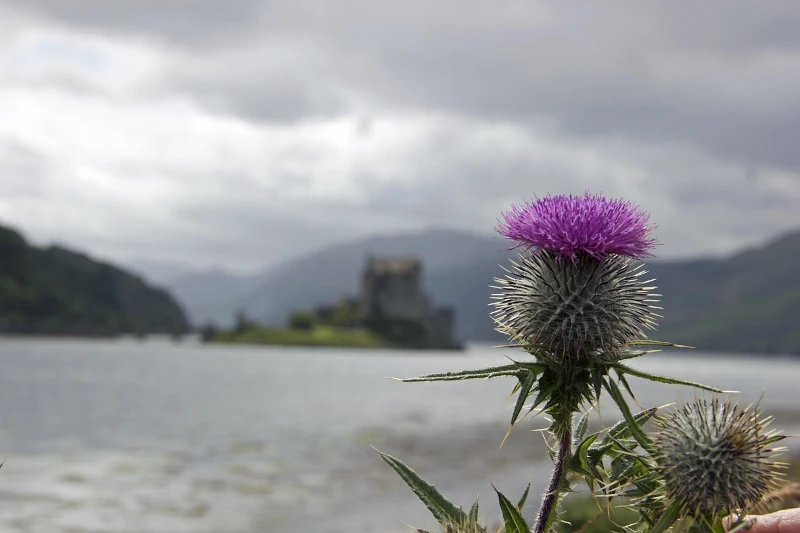
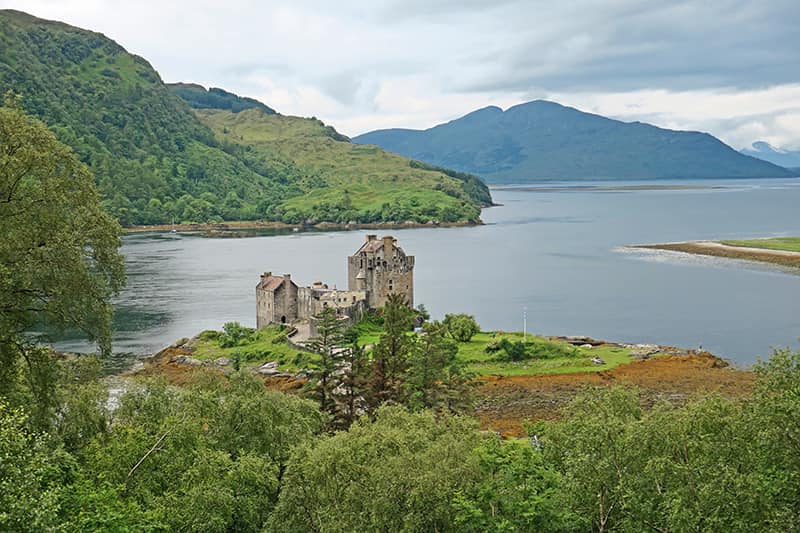
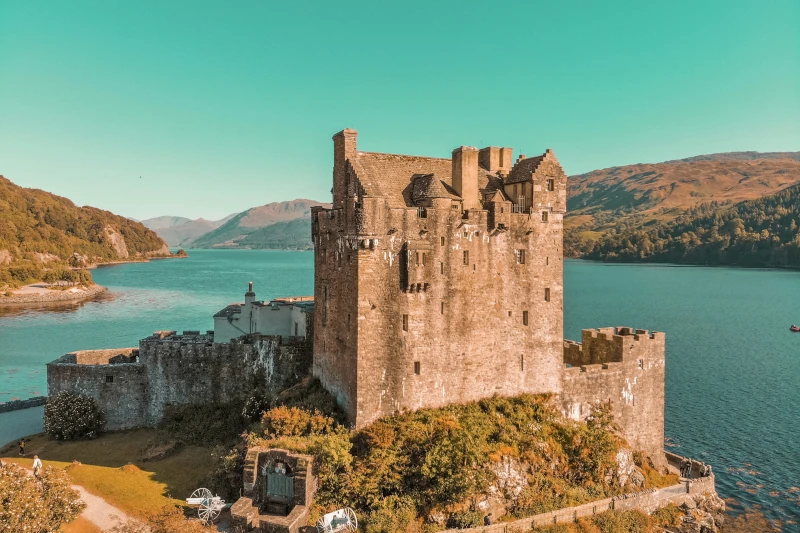
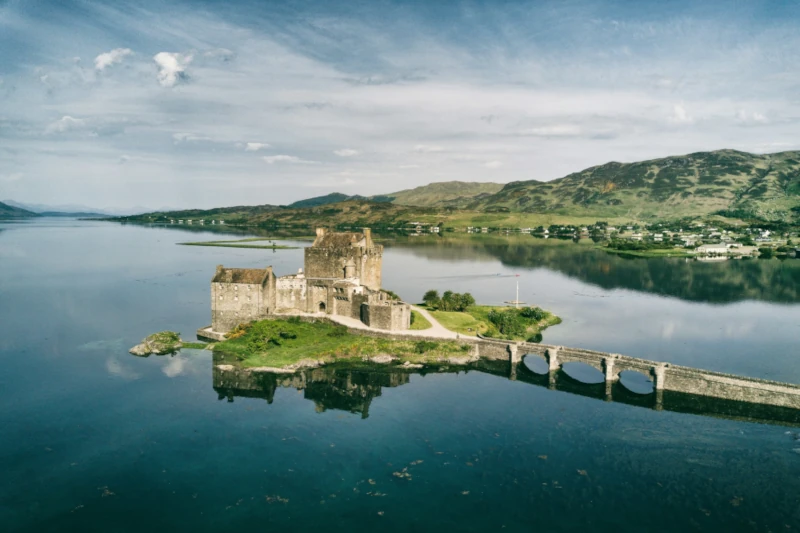
Situated amid stunning Scottish scenery is the iconic castle of Eilean Donan, with its castle walls dominating the surrounding lochs. Occupying a small island at the middle point of three great sea lochs, the castle’s breathtaking backdrop is unrivalled in Scotland. With mountains rising from all directions and still waters glistening all around it, its unique vantage point has views for miles around.
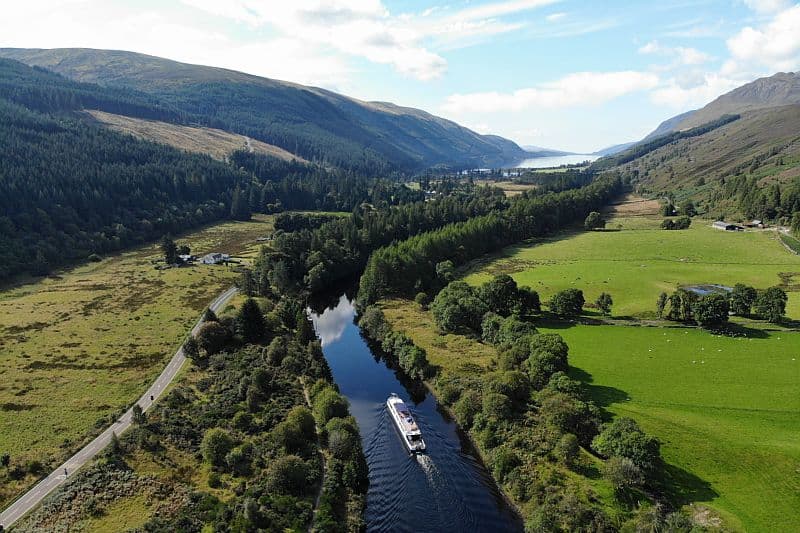
On a barge cruise aboard European Waterways’ Scottish Highlander or Spirit of Scotland, guests holiday on the canals and lochs of Scotland in luxury, before being chauffeured to the castle in a comfortable minibus to experience the wonders of this unique Scottish castle for themselves.
Where is Eilean Donan castle?
Eilean Donan can be found on the west coast of Scotland, where mountains rise in the distance and the forest of Kintail lies quietly in its sight. Located on a tiny island off the shore, it’s next to the village of Dornie and near Kyle of Lochalsh. The castle is at the confluence of three lochs; Loch Alsh, Loch Duich and Loch Long.
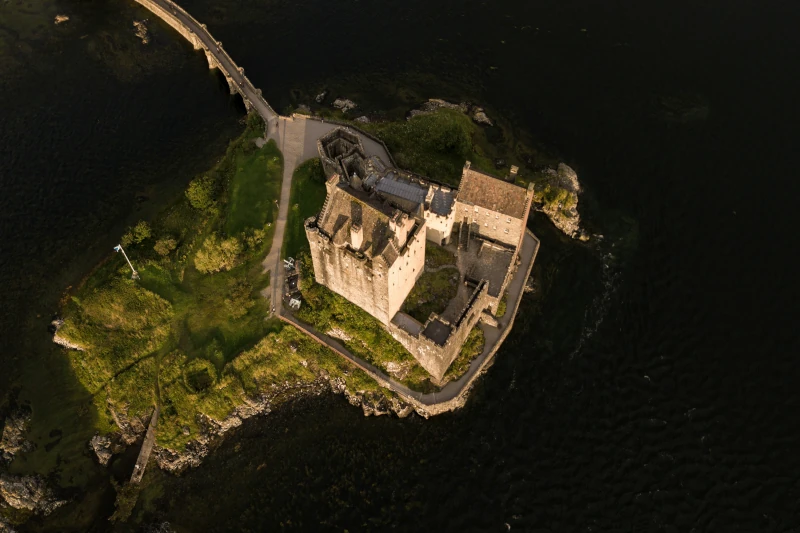
Reached on land at low tide, or by a stone footbridge when the sea is high, Eilean Donan is a must visit location for any visitors to the great Scottish Highlands. With views of the mountain range known as the Five Sisters of Kintail providing a dramatic backdrop and the Isle of Skye just a short ferry distance away, it has a unique vantage point of the western Ross-shire area of the Highlands.
When was Eilean Donan castle built?
As it is seen today, the castle is around 750 years old. Built in the mid thirteenth century, it’s seen many changes and has been remodelled at least four times. This spectacular fortification is the very epitome of what it is to be Scottish and encapsulates medieval life in Scotland.
A building was reputedly on the island as far back as 634AD, when legend says that a monastery was built to honour the Irish saint, St. Donnán of Eigg. In fact, ‘Eilean Donan’ is Celtic, translating literally into “island of Donnán”. St Donnán was martyred in 617AD and, if the island was inhabited by a religious order dedicated to him, it seems to have been abandoned at some point in the 7th century.
The Earls of Ross
The island was inhabited once again in the thirteenth century, when it was transformed into a fortification by the Earls of Ross. In the thirteenth century as Scottish kings ruled the highlands, Norse invasions with raids, pillaging and violence were common. Under Alexander II (ruled 1214-1249), fortifications were put in place to prevent the Vikings from reaching the region of Ross from the sea lochs that surround the island.
During this period,the island was a part of the Earldom of Ross, a title that held land in the Western highlands. The earldom was commonly given to allies of the King of Scotland and as an occupied fortress it was expected to protect the region from attack via the sea lochs.
The Mackenzies and MacRaes
It would later become a stronghold of the Mackenzie Clan, and their allies, the MacRaes, with further modifications being added. The Mackenzie clan were the primary clan and protectors of the Wester Ross area from the thirteenth century. By the 1300s, the Mackenzies had taken over control of Eilean Donan, allying with the MacRae clan. The island was garrisoned by the MacRaes and Mackenzies and its fortress was used as a stronghold to retain power and control in the local area.
And so it was that Eilean Donan stood for centuries against its majestic highland backdrop. The castle was at its largest during the thirteenth century, when it had towers and a curtain wall that dominated most of the island. However, by the fourteenth century, it had been reduced in size, potentially so that fewer men needed to be garrisoned there to protect it.
Throughout the 1400s, the Mackenzies and MacRaes became embroiled in a conflict with the crown to return Eilean Donan to the Earl of Ross, but they refused. In 1509, John Mackenzie of Kintail successfully obtained a charter for the Kintail area of Ross, which included the tidal island and castle of Eilean Donan. Under Mackenzie ownership, the castle was expanded on the east side to include an area for cannons.
Scottish Rebellion
However, the peaceful days were short-lived as the castle would become a target during the Jacobite rebellion. During the uprisings, the Mackenzies and MacRaes made a fatal error to side with the competition to the British throne.
After a tumultuous century of uprisings, many Scottish clansmen were still attempting to overthrow the protestant monarchs that had taken charge of the British throne, following the deposition of the Catholic king, James II in 1688. After an uprising failed in 1715, the Mackenzies and their allies, the McRaes, backed the Spanish forces sent to aid the Jacobite rebellion. In 1719, Spanish soldiers were sent to support the uprisings, and they were stationed at Eilean Donan Castle.
In an attempt to maintain order, the British government sent three British war ships to bombard the castle; The Flamborough, The Worcester, and The Enterprise. After three long days, the Spanish forces surrendered and were taken into custody. The gunpowder left by the Spanish soldiers was blown up, making an example of the Mackenzie clan and discouraging them from participating in future rebellions.
John MacRae-Gilstrap
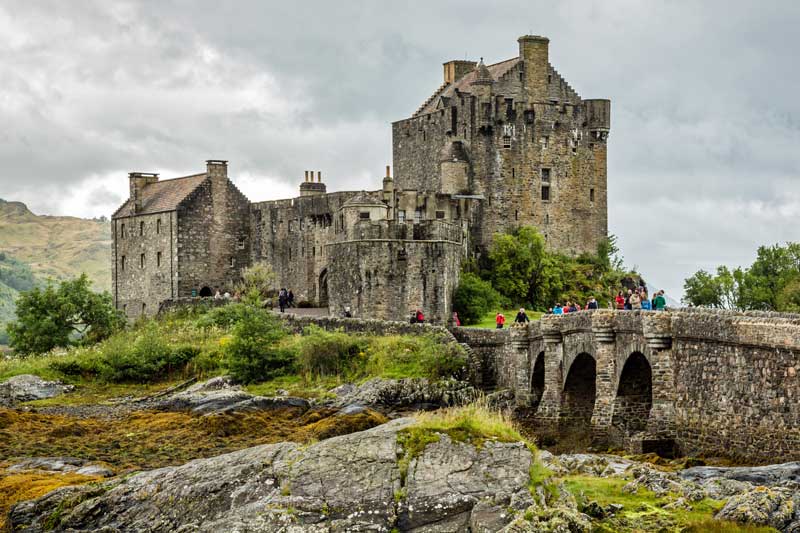
The Mackenzie’s involvement in the Jacobite rebellion resulted in its destruction in 1719, and its reconstruction by Lieutenant-Colonel John MacRae-Gilstrap in the twentieth century. It is this version of the castle that is seen by visitors today, though some of its original foundations remain.
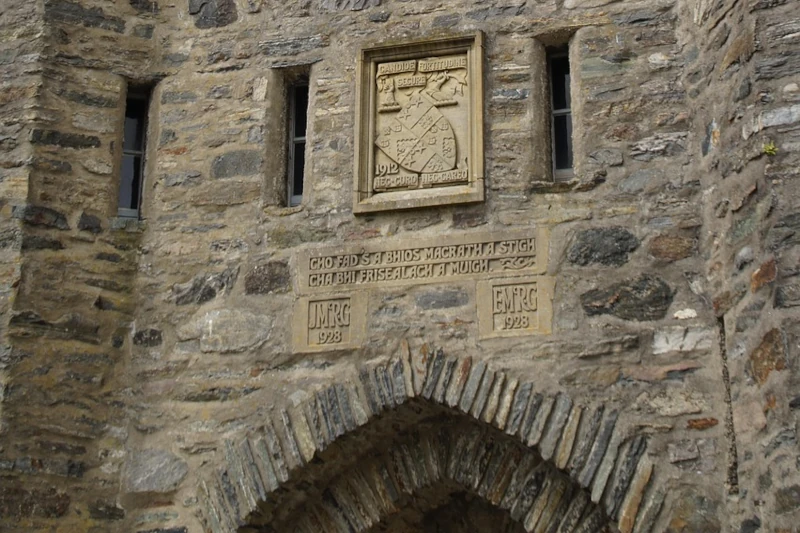
In 1911, Lieutenant Colonel John MacRae-Gilstrap purchased Eilean Donan with the intention of restoring her. It took over twenty years to remodel her, based on the surviving building plans of previous versions of the fortress. In July 1932, she was completed, mimicking her former glory; opening to the public in 1955.
Today, the castle is still owned by the MacRae family, but run by the Conchra Charitable Trust.
What is there to see at Eilean Donan Castle?
When you visit Eilean Donan, the first thing you’ll be taken aback by is the breathtaking views of the surrounding area. As you look around you, you’ll see the forests and mountainous region of Kintail and the nearby village of Dornie. With its own footbridge, designed to take visitors across to the castle, you can step onto the island where this Scottish castle is built, to admire these views from every direction.
Inside the castle, guests are offered a glimpse of medieval life, and scenes depicting what it was like to live in the castle during the thirteenth and fourteenth centuries show a challenging way of life, that was far from luxury. There are exhibitions about the Jacobite rebellion, the castle’s history and its use as a location in film. Guests can climb the castle towers, see the Great Hall and enjoy an array of grisly weapons and historic artefacts.
Why is Eilean Donan castle famous?
It has been claimed that the castle was used to shelter Robert the Bruce, who was the first king of Scotland to lead the country in a War of Independence against the English.
In the winter of 1306 through to 1307, Robert the Bruce is said to have stayed here, though there seems to be little evidence to support this claim.
The fortress island is located on the west coast of Scotland, in an area known as Wester Ross. George R R Martin based some of his fictional landscapes on the area for his famous novels series: ‘A Game of Thrones’. The made-up city of Westeros in ‘A Game of Thrones’ is named after Wester Ross in the Scottish Highlands.
What was filmed at Eilean Donan castle?
Eilean Donan serves as the headquarters in MI5 in the James Bond film’s ‘The World is Not Enough’. The film shows the fortress with its mountainous backdrop, before cutting to a scene inside the castle where M is holding a meeting about an exploded bomb. James Bond’s association to Scotland doesn’t end here, either. In Ian Fleming’s books, James Bond has Scottish heritage.
Another popular film it features in is the 1986 classic, ‘Highlander’. At a celebratory parade, cast march across the footbridge, with the fortress in the background. ‘Highlander’ mixes the locations of the castle and Glenfinnan village for these scenes. (You can read more on film locations we visit on our Scottish cruises here.)
Luxury Barge Cruises in Scotland
If Eilean Donan castle is on your bucket list, then a cruise of the Caledonian Canal on Scottish Highlander or Spirit of Scotland is a must. You’ll get a tour of this famous castle, cruise Loch Ness, see a falconry demonstration and so much more.
If you’d like to find out more about booking a cabin on a 6-night all-inclusive hotel barge cruise then speak to a member of our team today or book here.
 English
 Spanish
 French
 German
 Norwegian
 Portuguese
 Swedish
 Italian
 Russian
 Simplified Chinese
 Japanese