 English
 Spanish
 French
 German
 Norwegian
 Portuguese
 Swedish
 Italian
 Russian
 Simplified Chinese
 Japanese



Château de Josselin: History, Gardens & a Cruise Aboard Nymphea
There are few arrivals in France as enchanting as Josselin at dusk, where the soaring towers of Château de Josselin rise dramatically above the River Oust and the surrounding village. For guests beginning their journey aboard the hotel barge Nymphea it’s a step into a living story where medieval power, Breton identity, and refined French artistry meet.
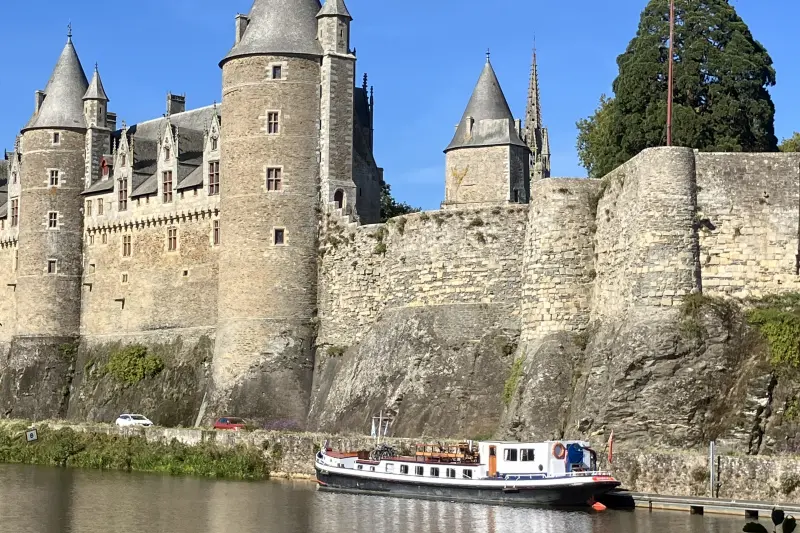
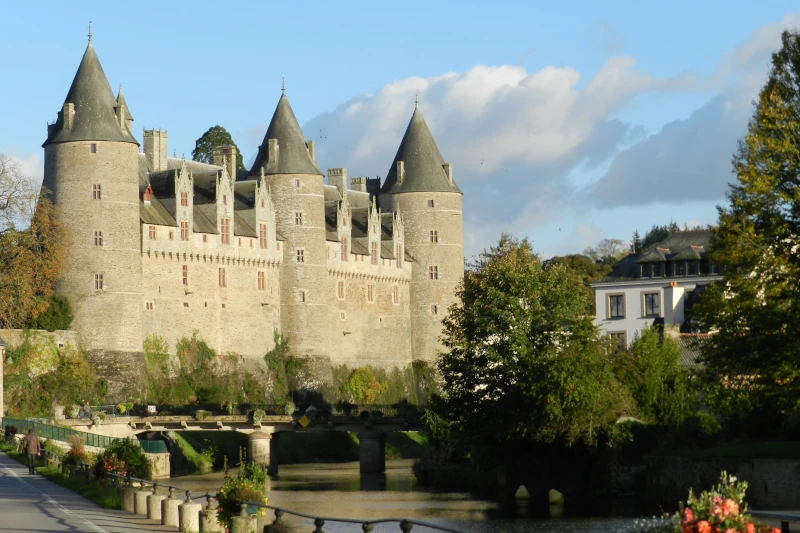
Nymphea, is moored directly and dramatically beneath the Château de Josselin’s imposing façade, appearing tiny in comparison. Three grand towers tower theatrically over you as you step onboard. As evening falls, the château glows softly. A quiet reminder that tomorrow, you’ll step inside its storied walls.
Château de Josselin History: From Medieval Fortress to Noble Residence
To understand the village of Josselin, you must begin with the Château de Josselin. Founded in the early 11th century by Guéthénoc, Viscount of Porhoët, the site was chosen for its commanding position above the Oust valley. An ideal location for surveillance and defense in a fragmented feudal landscape.
Its early history reflects the instability of medieval Brittany. In the 12th century, the fortress was destroyed by Henry II of England during his campaigns to control the duchy, only to be rebuilt shortly afterward by local lords loyal to the French crown.
This cycle of destruction and reconstruction was typical of a region caught between competing powers: the Dukes of Brittany, the Kings of France, and the Plantagenet empire.
A decisive transformation came in the late 14th century under Olivier de Clisson, one of the most powerful military figures of his time. Around 1370, he rebuilt Josselin into a formidable fortress, complete with a massive keep, multiple towers, and defensive walls designed to withstand artillery, reflecting the changing nature of warfare at the end of the Middle Ages.
Yet Josselin was not only shaped by war. It also stood at the crossroads of major Breton conflicts, including the aftermath of the War of the Breton Succession, during which the region’s allegiances were bitterly contested.
From Fortress to Renaissance Residence
By the late 15th and early 16th centuries, the château began its transition from a purely military structure into a residence of prestige. Under Jean II de Rohan, the austere fortress was softened with the addition of an elegant residential wing.
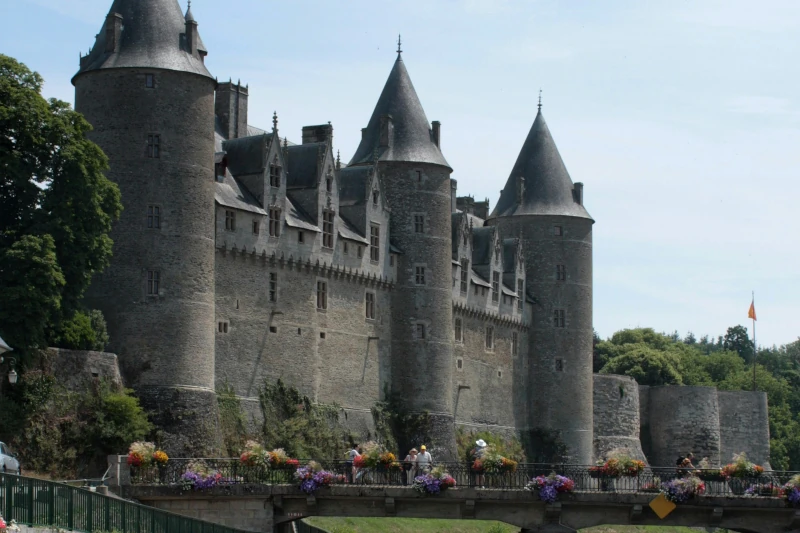
This new façade, still one of the château’s defining features, embodies the transition between Gothic flamboyant style and early Renaissance influence. Intricately carved granite details, ornamental dormer windows, and sculpted motifs reflect both French and Iberian artistic currents of the time.
The contrast remains striking today: on the river side, three massive defensive towers rise starkly above the water; on the courtyard side, a refined palace façade unfolds like lace carved in stone. This duality encapsulates a broader shift in European aristocratic life, from feudal warfare to courtly culture and display.
Wars of Religion and the Hand of Richelieu
The château’s fortunes changed dramatically during the French Wars of Religion. The Rohan family became leading figures in the Protestant (Huguenot) cause, particularly under Henri de Rohan.
Their opposition to royal authority led to severe consequences. In 1629, under orders from Cardinal Richelieu, large portions of the château, including its central keep and several towers, were deliberately dismantled to prevent it from serving as a rebel stronghold. Château de Josselin, once a symbol of feudal independence, was rendered strategically obsolete.
Decline, Revolution, and Revival
By the 18th century, like many aristocratic residences, the château had fallen into neglect as its owners spent more time at court. During the French Revolution, it was repurposed as a prison and storage facility, a fate shared by numerous noble estates across France.
Its revival began in the 19th century, when members of the Rohan family undertook extensive restoration. This period coincided with a broader Romantic rediscovery of medieval heritage in France, seen also in the restoration campaigns of figures like Eugène Viollet-le-Duc (though not directly involved at Josselin).
The interiors, largely refurnished during this era, reflect a historical reinterpretation rather than strict preservation, combining Renaissance revival furniture, family portraits, and tapestries to evoke the château’s noble past.
The Rohan Family and Their Lasting Legacy in Brittany
What makes the Château de Josselin particularly remarkable is its continuity. The House of Rohan has maintained ownership for centuries, making it one of the rare great French estates still inhabited by its founding lineage.
Their influence extended far beyond Brittany. Members of the family held key military, political, and religious roles, often navigating the delicate balance between Breton autonomy and integration into the French kingdom. Their motto, famously asserting their princely status, reflects this enduring ambition.
Even today, the château remains a lived-in residence, preserving a sense of authenticity that distinguishes it from purely museum-like monuments.
Exploring Josselin: A Town Shaped by Its Château
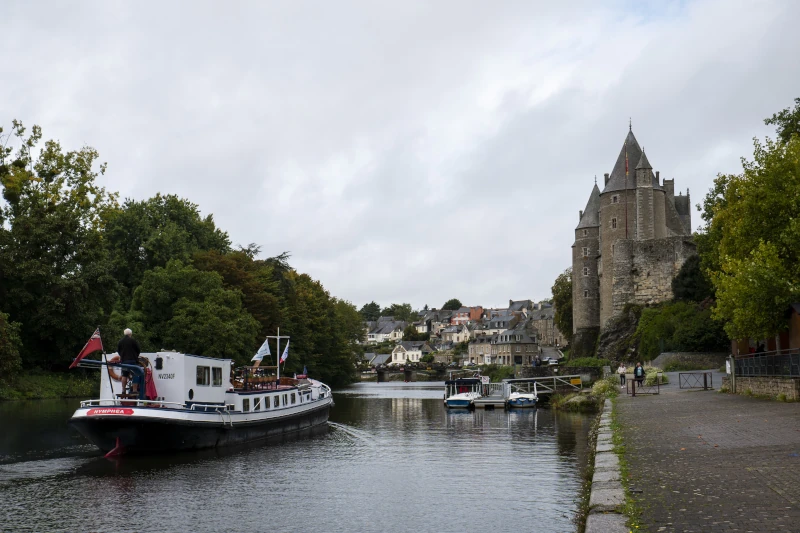
Beyond the château walls, Josselin developed in close relationship with its dominant fortress. Its medieval streets and timber-framed houses reflect centuries of economic life tied to the Rohan estate.
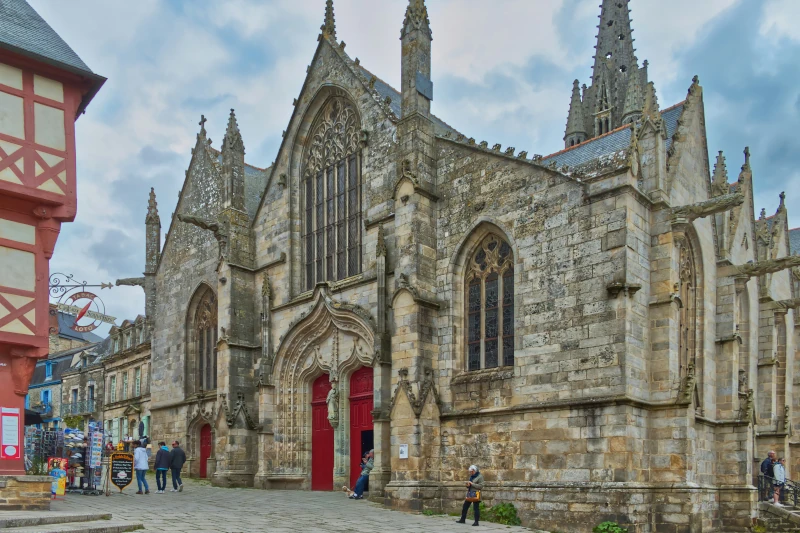
The Basilique Notre-Dame-du-Roncier stands as another key landmark, associated with local pilgrimage traditions dating back to the Middle Ages. Rebuilt after multiple destructions, it mirrors the resilience seen in the château itself.
Meanwhile, the Nantes–Brest canal, constructed much later in the 19th century, transformed the town into a modest commercial route before becoming the peaceful waterway visitors enjoy today.
Private Visit to Château de Josselin Interiors
The following morning begins gently, with breakfast on board before a leisurely stroll into town. The château awaits. But not as it does for the general public.
A private visit inside details rooms that evoke centuries of aristocratic life. The state rooms display Flemish tapestries, carved wooden furniture, and portraits of Rohan ancestors, offering insight into both status and daily life.
Among the notable objects are ceremonial pieces, historic furnishings, and artifacts linked to major events in French history, illustrating how closely the family was tied to national affairs. Some interiors also reflect 19th-century restoration tastes, blending authenticity with romantic reinterpretation.
The atmosphere is less that of a static museum and more that of a residence layered with time, each room bearing traces of different eras.
The Gardens of Château de Josselin by Achille Duchesne
Beyond the interiors, the château’s gardens offer a different kind of beauty. Redesigned in the early 20th century by Achille Duchesne, one of France’s most celebrated landscape architects, they reflect the formal elegance of classical French garden design.
Duchesne, known for his work at Vaux-le-Vicomte, brought a sense of structure and harmony to Josselin’s grounds. His work introduced terraces, geometric lawns, and carefully framed perspectives that complement the château’s Renaissance façade. At the same time, an English-style park softens the composition, reflecting evolving landscape aesthetics.
Later enhancements, including a rose garden and rare tree plantings, further enriched the grounds, creating a dialogue between medieval architecture and cultivated nature.
Why a Brittany Barge Cruise is the Ultimate Way to Experience Josselin
Starting a hotel barge cruise here feels intentional. Seen as a whole, Château de Josselin is not just a monument but an encompassing view of French history. Its stones bearing witness to feudal conflict, religious war, aristocratic ambition, and cultural renewal.
For travellers seeking more than surface beauty, Josselin offers depth. And for those beginning their journey aboard Nymphea, it provides a perfect opening chapter, one rich in story, effortlessly elegant, and unmistakably Breton.
If you would like to explore Chateau de Josselin and what makes Brittany a unique blend of medieval and renaissance history for yourself, don’t hesitate to get in touch with our team and book your barge cruise today.
Or Contact Us if you have any questions.