English
 Spanish
 French
 German
 Norwegian
 Portuguese
 Swedish
 Italian
 Russian
 Simplified Chinese
 Japanese


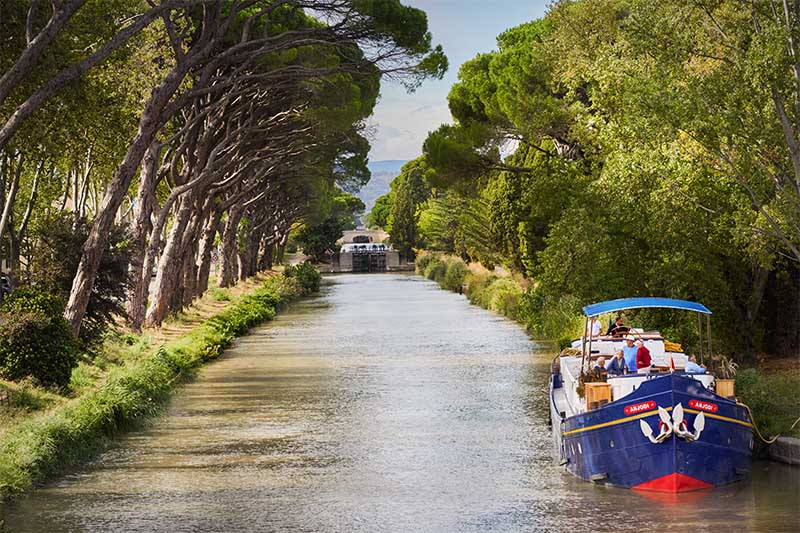
Travelling along the Canal du Midi on the hotel barge Anjodi, takes you on a journey into the land of Cathar history. We take you back to the 12th century, a time of hierarchy, feudalism, and crusades.
Cruising Through Cathar History on the Canal du Midi
Exploring Cathar Country
The term Cathar Country to describe this area is still used today, though the Cathars are long gone. It specifically refers to the most Languedoc and Midi-Pyrenees in Southern France where it borders with Spain.
Back in the Middle Ages, particularly during the 12th century when the Cathars were at their zenith, this area was not part of France as we know it today. Rather it was a mixture of kingdoms and fluctuated between France and Spain depending on marriages, deaths, alliances and power struggles. The border between France and Spain did not solidify into its current location until 1659.
Understanding Cathar History
The Cathars were a religious group that became popular throughout southern France and northern Italy, flourishing in Languedoc where they became the majority religion. The religion itself was a form of agnostic Catholicism, in other words believing in two Gods: a God of Good and a God of Evil. They claimed that their practices and beliefs dated back to earliest Christians, predating the Catholic Church. This has been confirmed by historians today as substantially correct.
Some interesting aspects of Cathar history was their abhorrence of killing, and this included animals, and a vegetarian diet was encouraged. During Medieval times in Europe, they were unusual in eschewing war and capital punishment, though they did have some that were designated for armed combat.
The unwillingness to kill stemmed from the fact that Catharism believed in reincarnation. As part of this, they believed a person could reincarnate as either a man or a woman. In consequence, this gave more equal opportunities to women. They also believed, because of reincarnation, that reproduction was a moral evil as it added to the suffering of the world. However, despite this belief, their numbers grew, until by the 1200’s, the southern region was almost completely Cathar.
The Beginning of the End of Catharism
Followers of Catharism were known as Cathar or Albigensian. The latter was a name after the city of Albi, where the religion first began. The actual use of the term ‘Cathar’ was coined by the Catholic Church.
Early on, the Catholic Church attempted to convert the Cathars. When this failed, they were denounced as a heretical sect leading to Pope Innocent III mounting a crusade against them. This was called the Albigensian crusade and lasted 19 years, weakening the Cathars severely. Then a medieval Inquisition was brought in, who ultimately eradicated them. This eradication of the Cathars is considered the germination of the concept of a police state, as well as being the first ideological genocide.
Discovering Cathar Castles
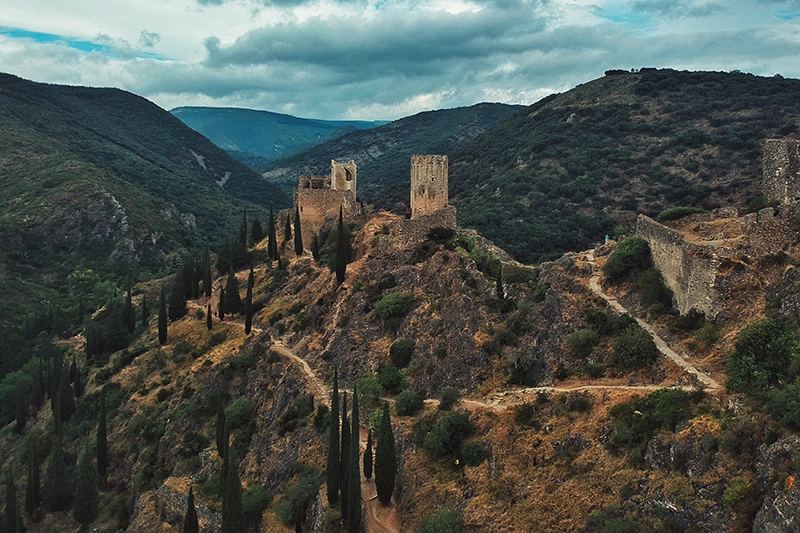
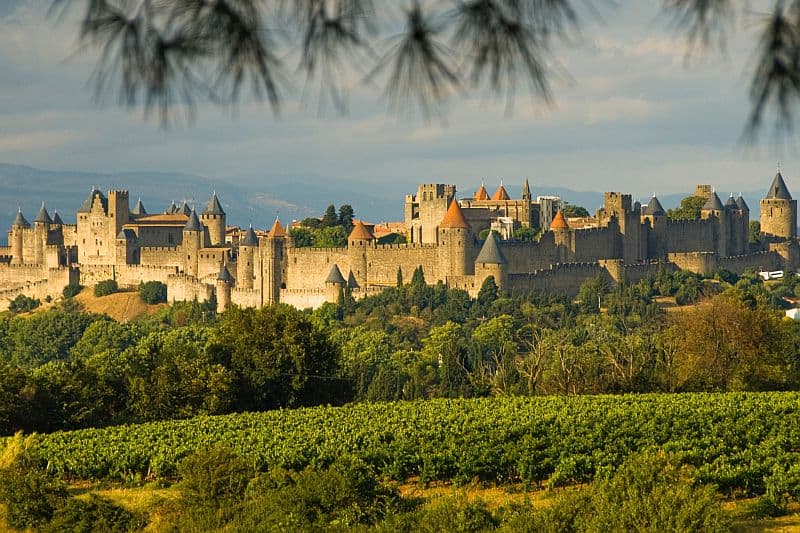
The Cathars built a lot of castles during their time. But Cathar castles aren’t just any old castles, these are real castles. Perched high atop hill and mountain tops, looking impossible to reach, let alone breach. This area of southern France, along the base of the French side of the Pyrenees, is littered with them. If you haven’t been to the foothills of the Pyrenees you are in for a scenic treat. It’s quite a dramatic landscape, with many large outcroppings of rocks. And perched on many of these outcroppings you will see these castles. So much so that you can sometimes see from one castle to another.
The Cathars built their castles in the 11th and 12th centuries, during the height of their power. They were built as both fortresses and refuge for the Cathars. In the flatter areas, they were built atop hills, which can be seen at Carcassonne, Mas-Saintes-Pulles, Fanjeaux and Laurac. In the more rugged areas, they were built dramatically on the mountain tops. Some prime examples today can be seen at Puilaurens, Termes, Montségur and Lastours-Cabaret.
Their building efforts were prolific, resulting in 14 castles, many of which can still be visited today, as well as additional minor fortresses, some now in ruins. These castles went on to be used during the crusades against them. Later still, when the area was annexed to France, they were strengthened and used to protect the border with Spain, until that border moved further away in the 17th century.
The Cathar Legacy
Although in the scheme of history the Cathars were short lived, their legacy lives on. It was because of this time, and particularly Pope Innocent III’s actions, that feudal Europe began to unite into national states.
In addition, the success of Catharism as a separate belief system laid the ground for the rise of others, including Protestantism. In consequence, it is possible to track back the broad split of Europe into Protestant north and Catholic south to the Cathars.
Cathar history also plays into modern day democracy, with tolerance and liberalism stemming from Languedoc’s Counts of Toulouse and the famous Troubadours, who wrote not only about courtly love but were also said to reflect Cathar doctrine
Book Your Journey Through Cathar History
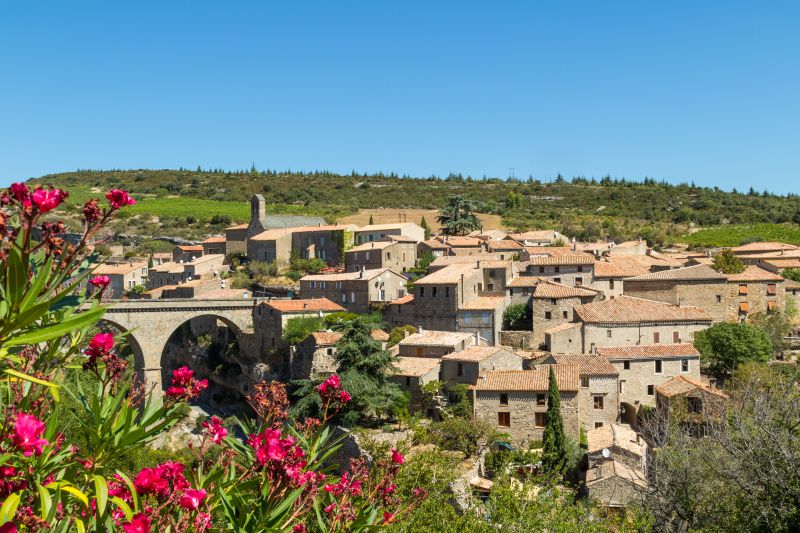
To travel along the Canal du Midi is to travel through Cathar history. The journey today is picturesque and tranquil, giving a chance to view beautiful villages, such as Minvere one of the most beautiful villages of France, as well as the dramatic remains of the Cathar castles that rise above.
If you’re inspired by history and would like to experience a luxury barge cruise along the Canal du Midi for yourself, why not speak to a friendly member of the European Waterways cruise team. Alternatively, order a brochure to consider all of our cruise options.
Discover our Canal du Midi hotel barges: Anjodi | Enchanté | Athos